II. This entry is the second in a series of commentaries on sustainable workplaces and examines work in the context of people’s lives. Sustainable Workplaces begin with policies and practices that address psychological sustainability: the mental, emotional and behavioral characteristics that allow workplaces to function and thrive over time while increasing the intelligence and energy of the people. We distinguish the different roles that work may serve for people, and share how meaningful value can be created within the workplace to increase the energy and alignment of the organization’s workforce.
The series began with an introduction to workplace sustainability and its role in the larger sustainability paradigm, and introduced the concept of psychological sustainability as a key element of sustainable workplaces.
Sustainability is a mindset. A mindset includes not only a way of thinking, but an attitude with associated feelings that support a way of thinking. While many SI readers may argue the necessity of sustainability as a fact, I have met numerous business people who think sustainability is idealistic or impractical, and even snicker at the idea of a company being, for example, green. (“It’s more expensive…duh!”)
For people with a sustainability mindset, who place high intellectual and emotional value on the ideas of caring about both the organizational means (broad stakeholder interests) and ends (profit) of economic activity, Psychological Sustainability may be at the core of the sustainability agenda. In other words, psychological sustainability may be a leverage point for more effectively achieving social, economic and environmental sustainability initiatives.
At MōD we focus on psychological sustainability for numerous stakeholders including customers, employees, partners, and investors. However here we’re exploring psychological sustainability in the workplace and address the employee specifically.
Work in context.
People have full lives. Work, family, health, community involvement, spiritual/philosophical pursuits, hobbies, and hopefully free-time are common elements in an adult’s life. Accepting that work fits into a more broadly conceived meaningful life may be a first step for some organizational leaders. Burnout is rampant and doesn’t support the organization’s bottom line if you consider the cost of turnover.
However, work can take on different roles for different people. CEO and Author Chip Conley identifies three potential roles of work in a person’s life:
- work as job (focus on survival: money, benefits, & pay)
- work as career (focus on success: esteem, recognition & power)
- work as calling (focus on meaning, purpose & calling)
No matter what the role of work for the employee, the function of a workplace is execution of a larger organizational objective and strategy. Since most companies may have a workforce that falls into all three categories, it is especially important to identify the psychological sustainability factors that everyone can agree on: mental, emotional & behavioral qualities that increase intelligence (including emotional and social intelligence) and energy.
To help with this task, Kim Cameron of the University of Michigan’s Center for Positive Organizational Scholarship (POS) reviews four ways that work can be experienced as meaningful, regardless of the role it plays in one’s life:
- the work is deeply connected to one’s personal values.
- the work concerns the well-being of human beings.
- the work is associated with community and fulfilling social relationships.
- the work has a long-term positive residual effect – creating a better future.
Cameron and Conley are both addressing the role and meaning of work in our lives, an important pursuit since the workplace is where the average person will spend most of his or her waking hours. When our workplace is meaningful it has an important function in our lives and reflects our deeper values and aspirations.
Thomas Moore writes about care of the soul at work, soul being that aspect of ourselves that links our physical and earthly existence to the eternal. Soul is mysterious and “not meant to be understood… Let us imagine care of the soul, then, as an application of poetics to everyday life.” Moore emphasizes the need for soul and meaning in the workplace as necessary for a fulfilled (psychologically sustainable) life, and observes that often times “we only consider function, and so the soul elements are left to chance… Where there is no artfulness about life, there is a weakening of soul.” When there is a weakening of soul, depression, emptiness, and even physical illness can result.
When companies do not understand soul, Moore believes they are
“ignoring the deeper evaluation of feeling and sensibility that gives work grounding in the human heart and not just in the brain…Often work spaces are devoid of imagination, so that the workers are left with a purely secularized feeling that doesn’t feed their souls… It seems to me that the problem with modern manufacturing is not a lack of efficiency, it is a loss of soul.” (p. 183)
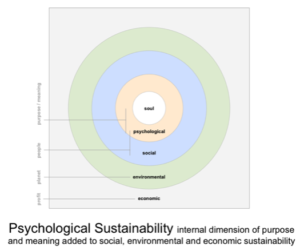
When soul is addressed it adds the internal dimension of Purpose to the traditional People, Planet, Profit triple bottom-line mindset. Supposing that people and talent development were to cultivate Psychological Sustainability in the workforce, conversations about soul and the meaningful subjective aspects of ourselves would be valued.
When work is a meaningful extension of ourselves and grounded in the human heart as Moore would say, we feel more engaged and energized. This deeper engagement supports Flow and peak performance states where head, heart, and actions are all working together in concert. Flow states contribute to human thriving and move us toward our individual and collective potential, something of interest to those continually measuring performance, productivity, social impact and overall effectiveness of our organizations.
A workplace infused with meaning contributes greatly to psychological sustainability and ultimately the larger sustainability agenda. While it’s not the entire story it contributes greatly to the energy people bring to their jobs, one of the goals of moving toward psychological sustainability and thriving in the workplace.
© 2010 Elizabeth M Topp PhD